Showing posts with label book. Show all posts

Monday, June 3, 2024

Reading to Answer Questions

Putting down my book, I stood up from the bench and walked over to my 10-year-old son by the water. His fishing line was tangled. Again. This was the third time he had needed me to fix something. He hadn't caught a single fish and was getting very upset. He loved the idea of fishing and had visions of catching impressive fish like those caught in the videos he watched. Sadly, he was not good at fishing and neither was I.

I recently wrote about how to read academic papers in volume. When I researched how to read academic papers, I also learned how to read more effectively in general. Those skills have helped me better achieve my goals, such as helping my son catch fish.
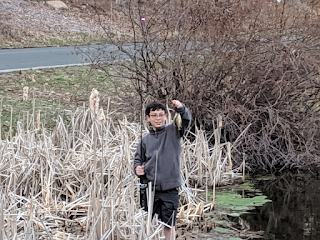

This post covers how I use books to answer my bigger questions, and is largely based on ideas from the book How to Read a Book by Mortimer Adler.
10 year old boy with glasses standing at the edge of a pond, holding a fishing rod in his right hand, and holding up a small fish from a line with his left hand.  To one side of him are reeds and cattails. To the other is water and lily pads. Behind him is brush growing at the edge of the lake.  Further behind the pond is a small road.
My son holding a small fish he caught.


Learning Through Books


To help my son catch fish, I had to learn both facts and skills. I needed to learn about a subject (fishing) and a skill (how to catch fish). It was one of my larger questions, requiring time and effort. I’ve investigated other larger questions focused on work problems such as working with a challenging colleague, personal goals such as remembering things better, and personal challenges such as supporting my family with a medical issue. The best way to learn facts and skills quickly is to learn from those who have already learned the topic. Books are a treasure trove of other people’s learnings.

I follow three main steps on a learning project:

  1. Find many potential resources

  2. Filter those results to a manageable number of the best resouces

  3. Extract what I need from those resources. 


In my life I am constantly asking questions and searching for answers. Only a few of those questions merit the time and effort required for this process. For those that do, I adjust my effort to my question and stop when I have what I need.

Find Many Potential Resources

I start with a wide search using the internet and my local library. I also ask friends, colleagues, and social media for suggestions. When I do this right, I turn up a lot of resources. For each resource, I’ll quickly check what I can about it, such as summaries and reviews, to see whether I think this book might be on topic. Key word searches often turn up things that are clearly unrelated to my question. For example, Incredible--and True!--Fishing Stories may or may not be entertaining, but it’s not going to help my son catch fish. I can immediately reject that book.
 
My search extends beyond books to include articles, blogs, podcasts, and videos. Books tend to be higher quality and I have a personal bias to the written word, but I want the best available resources regardless of its medium. 


Then I do a second search based on the results from the first search. Did I find other search terms? What other resources are related to these? Do any of these books reference other resources?
Filter For The Best Resources

Now I have a large list of books and other resources. I request as many of the books as I can from my local library. I download or bookmark the online resources. Then I scan all of these together quickly so that I can think about the ideas from multiple books at the same time. Speed is essential for that mixing of ideas. For each book I want to know:
 
  1. What is this book about?
  2. How does it address my question? What techniques does it propose? 
  3. What words does it use for my question? What do they mean? 
  4. Do I believe the answers this book proposes? Alternatively, is my bullshit detector going off? 

I quickly inspect each book, scanning the table of contents, reading the publisher's blurb, skimming the end of the last chapter, and checking for summaries at the end of key chapters. I take notes on anything that addresses my prompts, anything that catches my attention, and any new questions that arise as I read. By the time I’m done, the books are usually covered in sticky notes.

I look for common words and ideas, and I usually see patterns across the books. Sometimes several of the books have the same "revolutionary" or "game-changing" ideas. This used to annoy me, but I’ve since learned this is a great result. This common “revolutionary” idea is likely what I'm looking for. Other times I learn from overlapping words and ideas in the books, even if the books don't agree on everything. When they disagree I can see which ideas stand up to criticism and which fall over.

At this point, I have two follow-up questions:

  1. Does one book capture a common idea better than the others? 
  2. Are there interesting differences between the books? 

If one book does capture the key idea better than the others, I focus on that one. When there are interesting differences, I learn more from reading the books together than by reading them separately, just as I learned more from scanning them together.

Extract Answers 

I now have at least one book to read deeply. First, I revisit my existing notes to answer questions: What do I expect to get out of each book? What is common between them? What words do they use for important items? Where do they differ?
 
From these answers I form focused questions for each book: Book A says X, what does Book B say about that? Book C and D seem to differ on point C. Is one of them right? Is there something more complicated going on? Book E claims point D. What’s the evidence for it?

Next, I read each book, trying to answer my questions, still taking copious notes. I listen for the conversations among the books. The differences among books may be true disagreements requiring real thought and evaluation on my part. Or they may merely be different framings of the same idea. The common themes become clearer, and the differences enlighten me. In both cases I end up with a deeper understanding of the underlying issue.
 
When I’ve finished reading everything, I review and organize my notes. I often write a summary for myself. I hopefully have answers to my questions. If I don’t, I restart the process by looking for more sources focused on whatever is missing. If I’m really excited about the result, I may write a blog post or share my learnings with others.

Catching Fish

That day that I took my son fishing, I asked him two questions when we were back home: Would you like my help figuring out how to catch fish? Yes, he did. I told him if he wanted my help, we had to use the goal of "catch fish — any kind of fish." We couldn't only aim for the big fish he'd seen in videos. Would that still be worthwhile? He thought briefly: Yes, it would be.
 
I then got every book about fishing I could from my local library. I scanned each of them and noticed trends. It was clear that we should start by targetting small fish such as sunfish, with small hooks and bobbers, and we should fish in smaller bodies of water. I bought a couple of the more promising books, as well as the appropriate fishing gear, including the small hooks and bobbers. We then went to a local pond and he caught fish! That summer he caught a lot of fish. It was wonderful for him, and wonderful for me to help my son succeed at something that he loved so much.
 
I hope this post helps you achieve similar success with your large questions. I would love to hear about it when it does.

Thursday, July 2, 2009

Book Review: Technological Revolutions and Financial Capital

I just finished reading "Technological Revolutions and Financial Capital: The Dynamics of Bubbles and Golden Ages" by CarlotaPerez. This is a book I decided to read because I had heard senior IBMexecutives talk about it in the pasts. Two things struck me: one wasthat the IBM executives clearly valued what she had to say. The otherwas that her work made predictions about the current economiccrisis. While it is dense in part, overall I enjoyed the book andfound the model it contained quite compelling.
The basic idea of the work is that since the industrial revolutionthere have been 4.5 great surges of technological advances, eachlasting around 50 years. These surges were: the industrial revolution,the age of steam and railroads, the age of steel, the age of oil,cars, and mass production, and the information age. Each surgeoverlaps with the previous surge and goes through 4 distinct phases ofapproximately 10 years each: irruption, frenzy, synergy, and maturity.
The irruption phase begins with some big bang (identified inretrospect) identifying the new technology. The technology quicklygrows, while the old economy stagnates. In the frenzy stage, thefinancial capital that has invested in the new technology and newcompanies gets used to the staggering returns from the new technologyand expects them to continue. All businesses are expected to givelofty returns, more people enter the market, and there is assetinflation as the paper value of companies and other assets separatesfrom there productive value. As this continues, financial capitalstarts to invent ways to make money from money.
The frenzy phase ends with a market crash and correction. The crash isactually a very important part of Perez's model. The crash isnecessary to implement the new regulations needed for the newtechnological paradigm, and for the worlds of production capital tocome back into harmony with production capital. If this is done well,it can lead to a golden age in the synergy phase. The synergy phaserepresents the extension of the new technology to the rest of theeconomy, with the related increases in productivity.
At the end of the synergy phase, the new technology is starting tosaturate in its growth. This marks the beginning of the maturityphase. There are fewer and fewer parts of the economy to spread thenew technology too. Because of this, growth slows. As growth slows,there is a lot of idle capital looking for good things to investin. Additionally, the producers look into new areas and technologiesto prop up their now stagnating business. The idle capital and therenewed interest from established companies will provide theopportunity for the next technology to emerge, and the cycle repeats.
There are a few key themes and ideas in the book. One of them is theroles of financial capital and production capital through thecycle. Financial capital is the money, while production capital arethe people who make things. Financial capital can quickly move fromone technology to the next and is crucial in the creative destructionof old technologies and the emergence of new ones. However, productioncapital is key to successfully deploying the new technology throughoutthe economy. Additionally, production capital is very slow tochange. Production capital represents the people actually running thebusinesses. They have to have a very detailed understanding of thetechnologies, and need such an understanding to besuccessful. Therefore, they will stay with what they know as long aspossible.
Another key idea is the 50 year cycle. Perez argues that the 50 yearcycle is inherently human. Each of the great surges represents aparadigm shift in the technology and how people live. The ideasconsidered common sense are different in the different paradigms. Ittakes the first half of the 50 year cycle for the population tointernalize the new paradigm. This internalization is key to itscomplete exploitation in the synergy phase. Once the paradigm isinternalized, the new technology dominates everything and there isreal and good growth in the economy. It then takes another 20-30 yearsto fully exploit this internalization, before most gains have beenexploited. The force of this internalization is what really driveseverything. And the internalization inherently forces out any ideasthat do not fit within the paradigm. There very well may be wonderfultechnological advances that happen throughout the cycle. Incrementaladvances will be included within the new paradigm. Radical advanceswill be shunned, except in the maturity face. The new, radical ideasare just too risky for financial or production capital to invest inwhen the old paradigm is still providing good returns. It is only whenthe old paradigm stops providing good returns that the idle capitalshows up, allowing the next revolution to occur.